
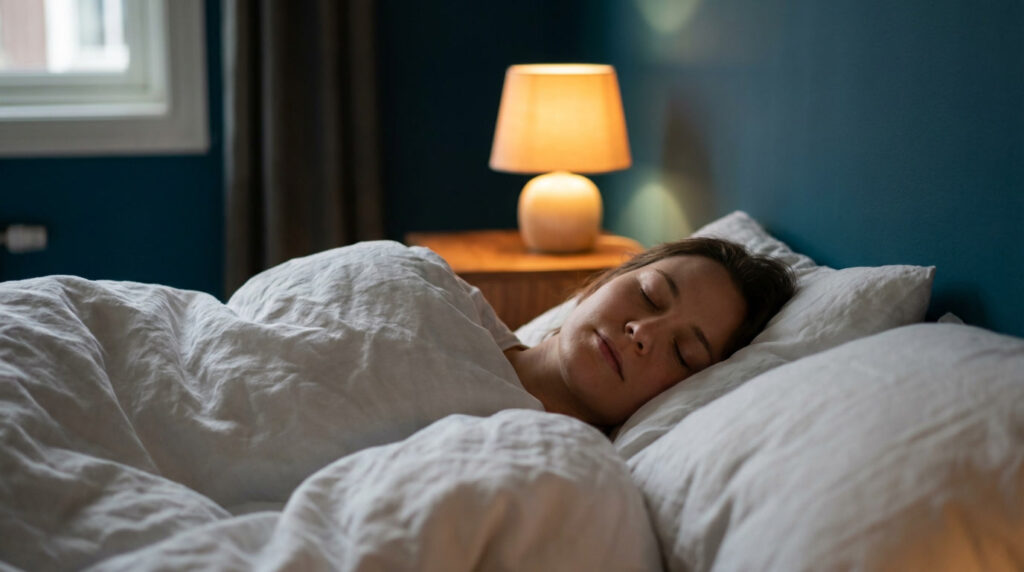
Anxiety and sleep have a complicated relationship.
Anxiety makes it harder to sleep. Poor sleep makes anxiety worse. Which makes sleep harder. Which makes anxiety worse. If you’ve been caught in this cycle for any length of time, you know exactly how exhausting — and how hopeless — it can feel.
Sleep meditation is one of the few interventions that works on both sides of this cycle simultaneously. It doesn’t just help you fall asleep — it addresses the anxious activation that prevents sleep in the first place.
But there’s a right way and a wrong way to use it. This guide covers both — the science behind why it works, the specific techniques most effective for anxiety-driven sleeplessness, and a step-by-step practice you can use tonight.
The 7-Day Mind Reset includes a complete sleep preparation protocol for each of the seven days — building progressively toward deeper, more consistent rest. Get it here →
Why anxiety disrupts sleep — and how meditation interrupts the cycle
To understand why sleep meditation works for anxiety, you need to understand what anxiety does to the sleeping brain.
Anxiety activates the sympathetic nervous system — the branch responsible for fight-or-flight responses. This activation produces a cascade of physiological changes: cortisol and adrenaline enter the bloodstream, heart rate increases, muscles tense, breathing becomes shallow, and the brain shifts into a state of heightened alertness and threat-scanning.
Sleep, on the other hand, requires the opposite state. It requires the parasympathetic nervous system to be dominant — heart rate slow, muscles relaxed, cortisol low, breathing deep and regular. The brain needs to feel safe enough to relinquish conscious control and enter the progressively deeper stages of sleep.
These two states are physiologically incompatible. You cannot be in full sympathetic activation and fall asleep. The question is how to shift from one to the other — reliably, on demand, without medication.
This is precisely what sleep meditation is designed to do. Through breath regulation, directed attention, and progressive relaxation, meditation activates the parasympathetic nervous system and signals to the brain that it’s safe to rest. It doesn’t just distract from anxious thoughts — it changes the physiological state that generates them.
A 2019 meta-analysis published in JAMA Internal Medicine found that mindfulness meditation produced significant improvements in sleep quality, sleep duration, and daytime fatigue in adults with sleep disturbances — comparable in effect size to pharmacological interventions, without the side effects or dependency risk.
The two types of nighttime anxiety — and why the distinction matters
Not all nighttime anxiety is the same, and the most effective meditation approach depends on which type you’re dealing with.
Type 1: Racing mind anxiety
Characterized by thoughts that won’t stop — replaying the past, rehearsing the future, problem-solving, planning, worrying. The mind is active and narrative; it’s telling stories and running simulations. The body may be relatively relaxed, but the head is loud.
Best approached with: techniques that redirect or interrupt cognitive activity — the cognitive shuffle, guided meditation with a voice to follow, or visualization practices that occupy the mind’s narrative capacity with something neutral.
Type 2: Body-based anxiety
Characterized by physical symptoms — heart racing, chest tight, shallow breathing, muscle tension, a sense of physical unease or dread that doesn’t attach to specific thoughts. The body is activated even when the mind is relatively quiet.
Best approached with: body-focused techniques — progressive muscle relaxation, body scan meditation, extended exhale breathing, and somatic awareness practices that work directly with the physical activation rather than trying to think their way through it.
Many people experience a combination of both. The protocol below addresses both layers — starting with the physiological and moving toward the cognitive.
A step-by-step sleep meditation for anxiety
This practice takes 15 to 20 minutes and can be done in bed. It’s structured in four phases that move progressively from physiological regulation to cognitive stillness.
Phase 1: Physiological reset (3–4 minutes)
Lie on your back with your arms slightly away from your body, palms facing up. This open position signals safety to the nervous system — a closed, curled position activates the body’s protective response.
Begin with extended exhale breathing: inhale through your nose for 4 counts, exhale slowly through your mouth for 8 counts. The extended exhale directly stimulates the vagus nerve, activating the parasympathetic response. Don’t force the breath — let it be slow and natural.
Do this for 6 to 8 cycles. Notice any shift in your heart rate, muscle tension, or the quality of your thoughts. The shift may be subtle at first — a slight loosening, a small drop in the sense of urgency. That’s enough. Continue.
Phase 2: Body scan release (5–7 minutes)
Once the breath has created a baseline of physiological calm, move your attention through the body systematically — not to relax it by force, but to notice what’s there and allow it to soften.
Start at the soles of your feet. Notice any sensation — warmth, pressure, tingling, numbness. Spend 10 to 15 seconds here before moving up. Ankles. Calves. Knees. Thighs. Hips. Lower back. Belly. Chest. Hands. Arms. Shoulders. Neck. Face.
When you reach an area that holds significant tension — often the jaw, shoulders, or abdomen — pause and breathe into it. Inhale and direct the breath toward that area; exhale and let the tension release with the breath. Don’t force the release. Invite it.
If your mind wanders to thoughts during the body scan, gently return your attention to whatever part of the body you were last aware of. The return itself is the practice — every time you bring your attention back to sensation, you’re strengthening the neural pathways that support present-moment awareness over anxious future-projection.
Phase 3: Cognitive anchor (3–5 minutes)
After the body scan, the mind is typically quieter — but may still have residual thoughts circling. This phase gives those thoughts somewhere to go without engaging with them.
Choose a simple, neutral anchor phrase — something like “I am safe. I can rest.” or simply “rest… rest… rest…” Repeat it mentally, slowly, in sync with your exhale. When thoughts arise — and they will — acknowledge them without judgment (“there’s a thought”) and return to the anchor phrase.
This isn’t suppression. You’re not telling the thoughts to stop — you’re choosing where to direct your attention. The thoughts are still there; you’re just not following them into their narratives. Over time, deprived of engagement, they lose momentum.
Phase 4: Surrender (open-ended)
Release the anchor phrase. Release the effort to meditate. Release the goal of falling asleep.
Simply rest. Eyes closed. Body still. Breath natural. No task. No technique. Just being in the body, in the dark, in the quiet.
If sleep comes, it comes. If it doesn’t, the rest itself is restorative. The absence of effort is the final piece — sleep cannot be achieved; it can only be allowed. The three phases before this one have created the conditions. This phase is the stepping aside.
This four-phase structure is built into the evening protocol of the 7-Day Mind Reset — with specific guidance for each night of the week as the practice deepens. See the full protocol →
Additional techniques for anxiety-driven sleep disruption
Guided sleep meditation
For minds that find self-directed practice difficult — particularly racing-mind anxiety where following instructions is easier than generating them — guided sleep meditations can be highly effective. A calm, slow voice provides an external anchor for attention, replacing the mind’s own narrative with something neutral and sleep-conducive.
Look for guided meditations that emphasize body awareness and breath rather than visualization-heavy content, which can paradoxically activate the mind. Duration of 20 to 40 minutes tends to work better than very short tracks — long enough for the physiological shift to occur and consolidate.
Healing frequencies
Music and audio tuned to specific frequencies — particularly 432Hz and 528Hz — are widely reported to reduce anxiety and promote sleep. The proposed mechanism involves resonance effects on the autonomic nervous system and shifts in brainwave activity toward slower, more sleep-compatible states.
While the research on specific frequency effects is still developing, the practical evidence from millions of users is consistent: slow, harmonically rich music at lower volumes creates a reliably calming effect that supports sleep onset. Pair it with the four-phase practice above for a combined physiological and auditory approach.
Yoga nidra
Yoga nidra — sometimes called “yogic sleep” — is a structured meditation practice that systematically guides the practitioner through progressively deeper states of relaxation, from waking consciousness toward the hypnagogic state just before sleep. It’s done lying down, typically guided by a voice, and takes 20 to 45 minutes.
Research on yoga nidra shows significant reductions in anxiety, cortisol, and sleep onset latency. It’s particularly effective for people with high cognitive anxiety because the structured guidance occupies the mind’s need for direction while progressively dismantling the physiological activation that prevents sleep.
NSDR (Non-Sleep Deep Rest)
Developed and popularized by neuroscientist Andrew Huberman, NSDR is a protocol based on yoga nidra principles — a guided deep rest practice of 10 to 30 minutes that produces measurable recovery of cognitive and physical resources without requiring sleep.
For people with severe sleep anxiety — where the pressure to sleep becomes its own source of activation — NSDR offers a useful reframe: the goal is deep rest, not sleep. This removes the performance pressure and often produces the conditions in which sleep arrives naturally.
What to do when meditation doesn’t seem to work
Sleep meditation is effective — but it takes practice. Here are the most common reasons it seems not to work, and what to do about each.
You’re expecting immediate results. The physiological shift that meditation produces deepens with repetition. The first few nights may produce only subtle changes. Most people notice consistent improvement after 5 to 7 nights of practice. Stay with it.
You’re trying too hard. Effort and sleep are incompatible. If you notice yourself straining to meditate correctly, straining to relax, or straining to fall asleep — that strain is the problem. Let go of the goal. Rest is enough.
The anxiety is daytime-rooted. If your nervous system is chronically dysregulated from daytime stress, no amount of nighttime practice will fully compensate. The bedtime meditation helps — but the deeper solution requires addressing what’s happening during the day. The guide to nervous system dysregulation and the guide to resetting a mentally exhausted mind cover the daytime side of this equation.
The technique isn’t matched to your anxiety type. Racing-mind anxiety and body-based anxiety respond to different approaches. If the four-phase practice above isn’t landing, try a guided meditation (for racing minds) or a longer, slower body scan (for body-based anxiety).
Building a consistent sleep meditation practice
The difference between occasional relief and lasting change is consistency. A meditation practice done three or four times is an experiment. A practice done every night for seven consecutive days begins to rewire the associations your brain holds around sleep.
The brain learns through repetition. When you begin the same sequence of actions every night before sleep — dimming the lights, the extended exhale breathing, the body scan — those actions become associated with sleepiness through classical conditioning. Over time, beginning the practice itself begins to trigger the physiological preparation for sleep.
Seven days of consistent practice is the minimum threshold for this conditioning to begin. It’s also the timeframe of the 7-Day Mind Reset — a complete morning-to-evening protocol that builds the sleep practice into a larger daily structure, addressing both the daytime conditions and the nighttime practice in sequence.
Sleep is not the enemy of anxiety — it’s the cure
Anxiety and poor sleep feel like a trap because they feed each other. But the cycle can be interrupted — not by fighting harder, but by creating the conditions that allow the nervous system to do what it already knows how to do.
Your brain knows how to sleep. Your body knows how to relax. Anxiety has temporarily overridden those systems — and meditation is one of the most reliable ways to restore access to them.
Start with the four-phase practice tonight. Not with the goal of falling asleep — with the goal of creating the conditions for rest. Let the rest become sleep in its own time.
The mind that’s been running all day is ready to stop. It just needs permission — and a way to get there.
At Relaxation and Balance, we create tools and content for people who want to quiet the mental noise — for good. Explore the rest of the blog, watch our YouTube channel, or start the 7-Day Mind Reset if you’re ready to commit to a full week of change.