
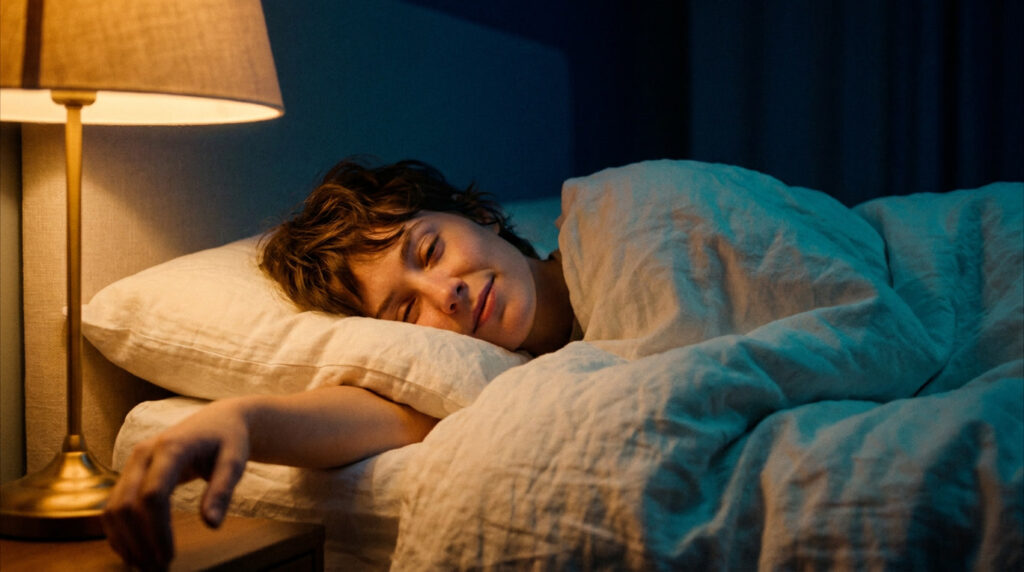
Falling asleep should be effortless. For millions of people, it isn’t.
Instead, it’s a nightly negotiation — with a mind that won’t stop, a body that won’t settle, and the compounding frustration of watching the minutes pass while sleep refuses to arrive. The harder you try, the more elusive it becomes. And the more elusive it becomes, the harder you try.
This guide breaks that cycle. Not with a single trick or a miracle technique, but with a clear understanding of why sleep initiation fails for anxious minds — and a sequenced set of interventions that address the actual mechanisms, in the order that produces the fastest and most reliable results.
Some of these techniques work in minutes. Others build over nights of consistent practice. The combination is what produces lasting change — not just faster sleep tonight, but a nervous system that arrives at bedtime ready to rest rather than ready to run.
The 7-Day Mind Reset includes a complete evening and pre-sleep protocol — the full structured approach to sleep initiation that goes beyond individual techniques to a coherent nightly system. Get it here →
Why falling asleep is hard — the real mechanism
Sleep initiation requires one thing: the inhibition of wakefulness. The brain has both sleep-promoting and wake-promoting systems running simultaneously — when the wake-promoting system is active enough to override the sleep-promoting system, you stay awake regardless of how tired you are.
The primary wake-promoting system that interferes with sleep in anxious people is the sympathetic nervous system and its associated hormones — cortisol and noradrenaline. When these are elevated, the brain receives a continuous “stay alert” signal that overrides the adenosine-driven sleep pressure that would otherwise initiate sleep. The result: exhaustion combined with wakefulness, the classic paradox of the anxious sleeper.
The second mechanism is cognitive arousal — the thinking mind running its content (planning, worrying, replaying, anticipating) in a way that activates the prefrontal cortex and maintains neural alertness even when the body is physically depleted.
The third mechanism is conditioned arousal — the bed itself, through repeated associations with wakefulness and frustration, has become a conditioned cue for alertness rather than sleepiness.
Techniques that address only one of these three mechanisms produce partial results. The most effective approach addresses all three in sequence — physiological, cognitive, and behavioral.
The fastest techniques — for immediate sleep onset
These techniques work in minutes for most people and address the physiological arousal that’s the most immediate barrier to sleep.
1. The 4-7-8 breathing method
Inhale through the nose for 4 counts, hold for 7, exhale completely through the mouth for 8. Repeat 4 to 6 cycles.
The extended hold and exhale produce the strongest available vagal stimulation from breath alone — a sharp parasympathetic response that lowers heart rate, reduces cortisol, relaxes muscles, and sends the brain a clear “safe now” signal. Most people feel a noticeable shift within the first two cycles. By the fourth or fifth, the physiological conditions for sleep initiation are significantly improved.
The 7-count hold is the distinctive element — it creates a mild hypercapnic state (slightly elevated CO2) that has additional sedating effects on the nervous system. If 7 counts feels uncomfortable initially, begin with 2-3.5-4 proportionally and build toward the full ratio.
2. The physiological sigh
For acute wakefulness spikes — the sudden alert feeling that sometimes arrives just as you’re drifting toward sleep — the physiological sigh is the fastest available reset: a double inhale through the nose (full inhale, then a short additional sniff to fully inflate the lungs) followed by a long, complete exhale through the mouth.
One to three repetitions produce an immediate drop in physiological arousal — enough to interrupt the spike and allow the drift toward sleep to resume. This technique, identified by neuroscientist Andrew Huberman at Stanford, works by maximizing the subsequent vagal activation through the completeness of the preceding inhalation.
3. Progressive muscle relaxation — rapid version
Tense every muscle in the body simultaneously for 5 seconds — feet, legs, abdomen, hands, arms, shoulders, face, all at once — then release completely. Repeat once or twice. The whole-body tension followed by release creates a contrast that produces a deeper relaxation than gradual PMR, and the physical focus required displaces the cognitive content that was maintaining arousal.
This rapid version is particularly useful when lying awake with residual tension — the kind that feels like the body just won’t let go despite mental effort to relax.
4. Cold water on the face
If arousal is high enough that breathing techniques aren’t gaining traction — a common experience during anxiety spikes or after a stressful evening — getting up briefly to splash cold water on the face activates the dive reflex, producing an immediate parasympathetic response through vagal activation. The heart rate drops measurably within seconds. Return to bed immediately after.
This technique is counterintuitive — it requires getting up when you’re trying to sleep — but for high-arousal states it’s often more effective than continuing to lie awake attempting breathing techniques that can’t gain physiological traction.
Techniques for the racing mind
Once the physiological arousal has been addressed, cognitive arousal is often the remaining barrier. These techniques address the thinking mind specifically.
5. The cognitive shuffle
Choose a random neutral word. Visualize it letter by letter — for each letter, construct a brief, vivid, unconnected mental image. A for “apple” (see a specific apple, its color and texture). B for “balloon” (a red one drifting upward). C for “cactus” (spiny, desert sun). Make the images random and slightly absurd. Don’t connect them into a narrative.
The cognitive shuffle works by occupying the mind’s narrative capacity with content that’s too random to maintain the coherent, anxiety-generating stories that characterize nighttime rumination. Most people find themselves asleep before completing the word. The technique mimics the natural random imagery of the hypnagogic state that precedes sleep — essentially tricking the brain into the pre-sleep cognitive state.
6. Counting backward from 300 by 3s
300, 297, 294, 291… This arithmetic task requires just enough cognitive engagement to displace the anxious narrative content, without being stimulating enough to generate further arousal. The monotony of the counting, combined with the mild mental effort required, produces a transition toward drowsiness for most people within a few minutes.
The specific numbers matter less than the principle — any mildly demanding but unstimulating cognitive task displaces the anxiety content. Spelling long words backward, reciting sequences of any kind, or mental geography exercises (naming every country on a continent, every city in a state) work on the same principle.
7. The body scan — moving attention from head to body
Anxious wakefulness is fundamentally located in the head — in thought, narrative, and future projection. Moving attention into the body — through a slow scan from the soles of the feet upward — provides a present-moment anchor that competes with the temporally displaced content of the anxious mind.
Start at the soles of the feet. Notice whatever sensation is present — warmth, pressure, tingling, or nothing. Move upward: ankles, calves, shins. Spend 10 to 15 seconds per area. If thoughts pull attention away, return to wherever you left off in the body. The goal is sustained present-moment attention to physical sensation — which is incompatible with the future-oriented worry that characterizes nighttime anxiety.
8. Anchor phrase repetition
Choose a simple, emotionally neutral anchor phrase — “rest now,” “release,” “safe and still” — and repeat it mentally in rhythm with slow exhales. The phrase provides a cognitive anchor that occupies the mind’s verbal processing capacity without generating further content. It’s not an affirmation or a suggestion — it’s a placeholder that gives the thinking mind something to do that isn’t anxiety.
The military sleep method — and what it actually involves
The “military sleep method” — reportedly used to train soldiers to fall asleep in two minutes under any conditions — has circulated widely online. The actual technique involves a specific sequence: relax the face completely (forehead, eyes, jaw), drop the shoulders and let the arms go heavy, exhale and relax the chest, relax the legs from thighs to feet, then spend 10 seconds with a clear mind using one of three images: lying in a canoe on a calm lake, lying in a dark hammock in a dark room, or repeating “don’t think, don’t think, don’t think.”
This method is essentially a combination of progressive relaxation (the body relaxation sequence) and cognitive displacement (the visualization or repetition), which explains why it works — these are well-established mechanisms. The “two minutes” claim is aspirational for most people starting from scratch, but with practice, the sequence does become faster as the nervous system learns the conditioned response.
It works best when the physiological arousal has already been addressed through breathing — attempting the relaxation sequence while in high cortisol activation is significantly less effective than using it as a second-stage technique after breathing has shifted the physiological baseline.
The NSDR protocol for fast sleep onset
Non-Sleep Deep Rest (NSDR), developed from yoga nidra principles by neuroscientist Andrew Huberman, is a guided protocol that systematically leads the nervous system into a deep rest state — not quite sleep but physiologically restorative and often transitioning naturally into sleep.
The protocol involves guided progressive relaxation of the body, combined with breath awareness and specific attention instructions that produce theta brainwave states — the hypnagogic state just before sleep. For people who find self-directed techniques difficult, an NSDR recording provides the external structure that guides the nervous system through the transition without requiring the self-direction that anxiety disrupts.
Multiple free NSDR recordings are available on YouTube and streaming platforms. The 10 to 20 minute versions are most appropriate for nighttime sleep initiation — long enough for the nervous system to enter the deep rest state, short enough not to produce full sleep stage entry that would fragment nighttime sleep architecture.
What not to do when you can’t fall asleep
Several common responses to sleep initiation difficulty reliably make it worse.
Checking the clock. Every clock check triggers a calculation — how long have I been awake, how much sleep can I still get, how tired will I be — that activates the prefrontal cortex and generates cortisol. Turn the clock face away from the bed. Keep the phone out of reach. Time checking is one of the most reliable ways to deepen the wakefulness it’s trying to measure.
Trying harder to sleep. Effort and sleep are physiologically incompatible. The harder you try, the more you activate the arousal systems that prevent sleep. Shifting the goal from “I must fall asleep” to “I’m going to rest comfortably” removes the performance pressure that’s driving the arousal loop.
Checking your phone. Phone use in response to wakefulness — to distract, to pass time, to check whether you have messages — adds blue light, cognitive stimulation, and emotional content to a brain that needs the opposite of all three. Every minute of nighttime phone use sets back sleep onset by significantly more than the minute itself.
Staying in bed indefinitely. Lying awake in bed for extended periods strengthens the conditioned association between bed and wakefulness. If 20 to 25 minutes have passed without sleep, get up — do something calm in another room and return only when genuinely sleepy. This is stimulus control, and it’s one of the most effective behavioral interventions in sleep medicine.
Building faster sleep onset over time — the compound approach
The techniques above produce the fastest available results for individual nights. But the most significant improvement in sleep onset speed comes from what happens during the day — specifically, from the consistent reduction of the daytime cortisol load and nervous system activation that produces the evening hyperarousal that delays sleep.
Morning light exposure, consistent wake times, midday movement, afternoon caffeine cutoff, and evening wind-down routines collectively produce a nervous system that arrives at bedtime significantly less activated than one without these practices. The in-bed techniques then work faster and more reliably from this lower-activation baseline.
This is the architecture of the 7-Day Mind Reset — a complete daily structure that reduces the daytime inputs driving evening hyperarousal, combined with a specific evening and pre-sleep protocol that addresses the remaining arousal at bedtime. The compound effect of both together — daytime regulation and nighttime practices — produces sleep onset improvement that neither alone can match.
After 7 days of consistent implementation, most people report falling asleep significantly faster than before — not because they’ve found the right trick, but because they’ve addressed the underlying conditions that were making sleep initiation hard in the first place.
Sleep comes when conditions are right — not when you try harder
The most important shift in understanding sleep initiation is this: sleep is not something you do. It’s something that happens when you create the right conditions. The effort to sleep is itself one of the primary conditions that prevents it.
The techniques in this guide don’t help you fall asleep. They help you create the conditions — physiological, cognitive, and behavioral — in which sleep arrives naturally. The difference in framing matters as much as the techniques themselves.
Tonight: breathe first. Four counts in, seven hold, eight out. Let the body soften. Let the mind find something random to follow. And stop trying to sleep.
Sleep will do the rest.
At Relaxation and Balance, we create tools and content for people who want to quiet the mental noise — for good. Explore the rest of the blog, watch our YouTube channel, or start the 7-Day Mind Reset if you’re ready to commit to a full week of change.