
Most sleep advice focuses on what you do before bed — the routines, the environment, the breathing practices. Almost none of it addresses what happens to your body once you’re actually lying down.
But the position in which you sleep — how your body is arranged for the 6 to 8 hours of the night — has measurable effects on your nervous system, your breathing mechanics, your cortisol clearance, and the quality of the sleep you get. For people with anxiety, these effects are not trivial.
This guide covers the science of sleep position and anxiety — which positions support nervous system regulation and which actively work against it, why posture affects the stress response even during sleep, and the practical adjustments that can make a meaningful difference to sleep quality for anxious sleepers.
The 7-Day Mind Reset includes specific sleep preparation practices — including body positioning and pre-sleep somatic exercises — designed to optimize the nervous system’s recovery during sleep. Get it here →
Why sleep position affects anxiety and the nervous system
The connection between body posture and the autonomic nervous system is well-established in waking research — we know that open, expansive postures activate the parasympathetic system and closed, contracted postures activate the sympathetic system. What’s less widely recognized is that this relationship doesn’t disappear during sleep.
Several mechanisms connect sleep position to nervous system state and anxiety.
Breathing mechanics. Different sleep positions have dramatically different effects on breathing quality. Airway patency, diaphragm movement, and the depth of breath all vary with position — and breathing quality during sleep directly affects the balance between sympathetic and parasympathetic activity throughout the night. Positions that restrict breathing produce more frequent micro-arousals, higher nighttime cortisol, and lighter, less restorative sleep.
Vagal tone during sleep. The vagus nerve — the primary pathway of the parasympathetic system — has branches that are mechanically affected by body position. Positions that compress the chest or neck can reduce vagal conductance, while open positions that allow free diaphragmatic movement support better vagal tone and therefore better parasympathetic dominance during sleep.
The protective curl and anxiety posture. Anxiety produces a characteristic postural pattern in waking life: shoulders rolled forward, chest contracted, body curved into a mild protective curl. When anxious people sleep, they often default to versions of this same protective posture — curled fetal positions with the chest and abdomen contracted. This posture, maintained for hours during sleep, reinforces the physical holding patterns of anxiety and reduces the deep diaphragmatic breathing that would support recovery.
Lymphatic and glymphatic drainage. The glymphatic system — the brain’s waste-clearance mechanism, which removes the metabolic byproducts of waking neural activity during sleep — operates most effectively in certain positions. Research by Maiken Nedergaard at the University of Rochester found that the glymphatic system is 60% more active during sleep than waking, and that body position significantly affects its efficiency. More effective glymphatic clearance means better removal of cortisol, inflammatory markers, and metabolic waste that would otherwise accumulate and contribute to the brain fog and mood disruption associated with anxiety.
The major sleep positions and their effects on anxiety
Back sleeping (supine) — the best position for nervous system recovery
Sleeping on your back with arms slightly away from the body and legs uncrossed is, from a nervous system perspective, the most advantageous position for anxious sleepers. Here’s why.
The supine position opens the chest and allows the diaphragm to move freely in all directions — producing deeper, more complete breaths than any other sleep position. This deep diaphragmatic breathing maintains higher vagal tone throughout the night, supporting parasympathetic dominance and better cortisol clearance during the sleep hours.
The open arm position — arms slightly away from the sides, palms facing up — is the opposite of the protective curl that anxiety generates. It’s the position of openness and safety rather than defense, and research on the bidirectional relationship between body position and mental state suggests that maintaining this position during sleep may reinforce the nervous system’s experience of safety over the course of the night.
The supine position also appears to support glymphatic drainage, based on Nedergaard’s research — though the evidence is more robust for the lateral position (see below).
The limitation: Back sleeping worsens snoring and sleep apnea in susceptible individuals, because gravity pulls the tongue and soft palate backward into the airway. For people with sleep-disordered breathing — which itself drives anxiety through chronic sleep fragmentation and hypoxia — back sleeping may be contraindicated. If you snore significantly or have been diagnosed with sleep apnea, lateral sleeping is likely preferable despite the other advantages of the supine position.
Left side sleeping — the best supported position for most anxious sleepers
Left lateral sleeping has the strongest overall evidence base for sleep quality in most adults, including anxious sleepers — for several reasons.
Glymphatic drainage appears to be most efficient in the lateral position, based on animal studies and the human neuroimaging research that followed them. The lateral cerebrospinal fluid flow that facilitates glymphatic waste clearance — removing the cortisol and inflammatory metabolites that accumulate during waking — is enhanced in this position. More efficient overnight brain cleansing means a clearer, less anxious, and more cognitively capable brain upon waking.
Left lateral sleeping specifically keeps the airway more patent than right lateral sleeping, due to the anatomical relationship between the heart, aorta, and airway in the chest. It also supports gastric acid clearance and reduces acid reflux — a common nocturnal symptom in anxious people whose vagal dysregulation affects digestive function.
The left side position also puts the heart in a slightly lower position relative to the aorta, which some research suggests reduces cardiac workload during sleep — a mild but meaningful benefit for people whose anxiety produces chronically elevated heart rate and cardiovascular strain.
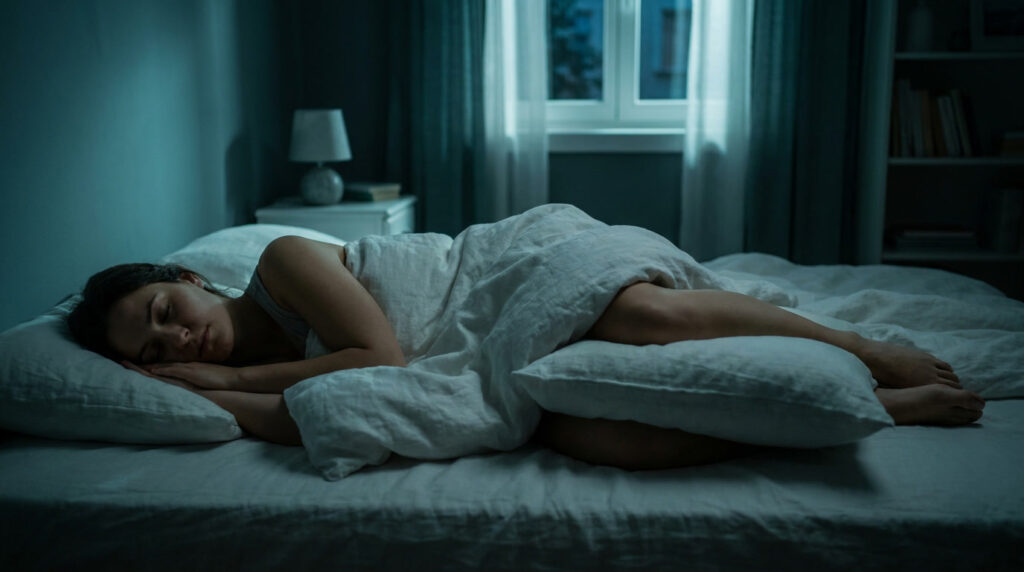
How to optimize left side sleeping: Place a pillow between the knees to maintain spinal alignment. Avoid curling tightly into a fetal position — keep the body relatively elongated rather than contracted. A supportive pillow that keeps the head and neck in neutral alignment (not tilted up or down) reduces the neck tension that anxious sleepers commonly develop in lateral positions.
Right side sleeping — generally fine, with caveats
Right lateral sleeping is similar to left lateral sleeping in most respects — better for airway patency than supine sleeping, better for glymphatic drainage than stomach sleeping. The primary distinction is the slightly less favorable cardiac and digestive positioning compared to left lateral.
For most people without significant acid reflux or cardiac conditions, right side sleeping is a reasonable option. If you find yourself naturally drifting to the right side during the night, it’s not significantly problematic — the differences between left and right lateral are meaningful at the population level but small for individual variation.
Stomach sleeping (prone) — the most problematic for anxiety
Prone sleeping — lying on the stomach — is the most disadvantageous position for anxious sleepers, for several interconnected reasons.
The prone position severely restricts diaphragmatic movement — the weight of the body pressing down on the chest and abdomen prevents the free expansion that deep breathing requires. This mechanical restriction produces shallower, more effortful breathing throughout the night, maintaining a higher sympathetic tone and preventing the deep parasympathetic restoration that good sleep should provide.
To breathe in the prone position, the head must be rotated to one side — producing chronic asymmetric neck tension that accumulates over the night’s duration and contributes to the muscle tension and headaches that many anxious people experience upon waking. The neck rotation also compresses cervical blood vessels and can reduce blood flow to the brain.
The prone position also produces a characteristic posture of mild thoracic extension — the back arched slightly over the stomach — that some somatic therapists associate with a defensive response pattern, though the research on this specific connection is more speculative than the breathing and physical mechanics data.
If you’re a habitual stomach sleeper who’s reluctant to change, transitioning gradually — starting on your side and placing a thin pillow under your stomach to reduce spinal extension — can make the transition more comfortable. Most habitual stomach sleepers can successfully shift to lateral sleeping within 2 to 3 weeks of consistent practice.
The fetal position — complicated
Curled tightly on the side in a fetal position is the most common sleep position — and for anxious people, it deserves specific attention.
Mild lateral curling with knees slightly drawn up is natural and not problematic. The issue arises with tight fetal curling — knees drawn fully toward the chest, shoulders rolled forward, body contracted. This extreme protective curl restricts breathing, compresses the hip flexors and psoas (muscles that hold chronic stress activation), and maintains the body in the physical posture of defense and contraction throughout the night.
For anxious people who are already dealing with chronic physical tension, tight fetal sleeping reinforces rather than releases these patterns. The transition to a more open lateral position — same side, but with legs more extended and the body less contracted — is a meaningful upgrade that doesn’t require learning an entirely new sleep position.
Practical adjustments for anxious sleepers
Beyond choosing a better primary sleep position, several specific adjustments support nervous system recovery during sleep.
Unclench the jaw before sleep. Anxious people almost universally clench or hold the jaw — a pattern that continues during sleep and contributes to the jaw tension, headaches, and neck pain that anxious sleepers commonly report. Consciously releasing the jaw — allowing the back teeth to separate, the lips to close loosely, and the tongue to rest gently against the lower teeth — before sleep and upon waking provides an immediate reduction in this tension. A custom mouthguard, prescribed by a dentist, can prevent overnight clenching in severe cases.
Soften the hands. Anxious sleepers often unconsciously grip — hands slightly fisted, fingers curled. Consciously opening and relaxing the hands before sleep — palms up, fingers gently spread — releases a point of chronic tension and provides a proprioceptive signal of openness that supports the parasympathetic system.
Position the pillow for neutral neck alignment. The pillow should keep the head and neck in the same alignment as upright standing — not elevated or dropped. A pillow that’s too thick (common in lateral sleeping) or too thin (common in back sleeping) produces chronic neck tension that the sleeping body registers as a low-level stressor throughout the night.
Use a pillow between the knees in lateral positions. In side sleeping, the upper knee tends to drop forward, rotating the pelvis and producing lower back tension. A pillow between the knees maintains pelvic alignment and reduces the muscular holding that this rotation requires — allowing deeper physical relaxation across the hip and lower back that anxious bodies commonly hold.
Do the pre-sleep body scan in your chosen position. The body scan covered in our guide to sleep meditation for anxiety is most effective when done in the position you intend to sleep in — allowing you to notice and release the specific tension patterns that your chosen position produces before sleep begins rather than carrying them through the night.
Changing sleep position — the practical reality
Sleep position is partly habitual and partly unconscious — most people shift positions multiple times during the night without awareness. This means that changing your primary sleep position requires intentional starting position plus some tolerance for the fact that you may shift during the night.
The most effective approach: choose your target position, arrange yourself in it consciously each time you get into bed or return to bed, and accept that nighttime shifting is normal and doesn’t undermine the practice. Starting in the optimal position — even if you later shift — increases the proportion of the night spent in that position and produces meaningful differences in sleep quality over time.
For habitual stomach sleepers trying to transition to lateral sleeping: place a body pillow in front of you to prevent rolling forward, and put a thin pillow under your stomach for the first weeks to reduce the comfort difference. Most people adapt within 2 to 4 weeks.
The body’s overnight posture matters
Sleep position is not the most important variable in sleep quality for anxious people — the nervous system regulation practices, the circadian habits, and the sleep hygiene fundamentals covered throughout this blog have more impact. But it’s a meaningful and consistently overlooked variable, and for people who have optimized other aspects of their sleep practice and still wake with tension, jaw pain, shallow breathing patterns, or an anxious morning state, sleep position is a rational next place to look.
The body spends a third of its life in the position you choose to sleep in. For a nervous system trying to recover from the day’s anxiety and stress, that third of the day matters more than most people realize.
Tonight: left side, pillow between the knees, jaw unclenched, hands open. Start there. See what changes about the quality of the morning.
At Relaxation and Balance, we create tools and content for people who want to quiet the mental noise — for good. Explore the rest of the blog, watch our YouTube channel, or start the 7-Day Mind Reset if you’re ready to commit to a full week of change.