
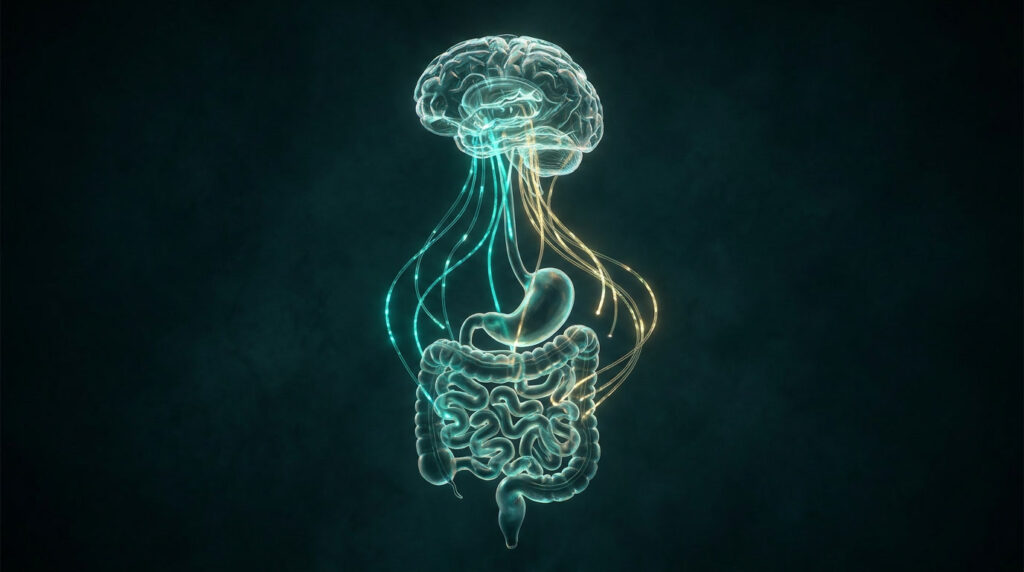
You’ve felt it before — the stomach that clenches before a difficult conversation, the nausea before a presentation, the digestive system that seems to have its own emotional life entirely separate from your conscious mind.
This isn’t coincidence or psychosomatic imagination. It’s one of the most significant discoveries in neuroscience of the past two decades: the gut and the brain are in constant, bidirectional communication through a network of nerves, hormones, and immune signals so complex and influential that researchers now refer to the gut as the “second brain.”
And the implications for anxiety are profound. Because if the gut is driving the brain as much as the brain is driving the gut — if the trillions of microorganisms living in your digestive system are influencing your mood, your stress response, and your anxiety level — then addressing anxiety requires looking below the neck, not just inside the head.
This guide covers what the gut-brain connection actually is, how it drives and maintains anxiety, and the practical interventions that address anxiety through the gut pathway.
The 7-Day Mind Reset addresses anxiety through multiple physiological pathways — including the nervous system and dietary inputs that directly affect the gut-brain axis. Get it here →
What the gut-brain connection actually is
The gut-brain connection — formally called the gut-brain axis — is a bidirectional communication network linking the enteric nervous system (the nervous system of the gut) with the central nervous system (the brain and spinal cord) through multiple pathways.
The enteric nervous system — the second brain
The enteric nervous system (ENS) is a network of approximately 500 million neurons lining the gastrointestinal tract — more neurons than in the spinal cord. The ENS can operate independently of the central nervous system, regulating digestion, gut motility, secretion, and blood flow without input from the brain. It is, in a meaningful sense, a second brain — embedded in the gut wall and capable of independent neural processing.
The ENS communicates with the brain primarily through the vagus nerve, which carries signals in both directions: from the brain to the gut (regulating digestive function) and — more significantly — from the gut to the brain (reporting on the gut’s state). Approximately 80 to 90% of vagal fibers carry information upward, from gut to brain, rather than downward. The gut is informing the brain far more than the brain is directing the gut.
The gut microbiome — the third brain
Living within the gut is a community of approximately 100 trillion microorganisms — bacteria, fungi, viruses, and archaea — collectively called the gut microbiome. This community weighs approximately 1.5 kilograms and contains more genetic material than the entire human genome.
The gut microbiome is not a passive bystander in gut-brain communication. These microorganisms produce neurotransmitters and their precursors, synthesize short-chain fatty acids that affect brain function, regulate the immune system, maintain the gut barrier, and produce signals that directly influence the vagus nerve and the HPA axis — the stress response system.
Approximately 95% of the body’s serotonin is produced in the gut, not the brain. This serotonin is produced by enterochromaffin cells in the gut wall in response to signals from the gut microbiome — meaning the bacterial community living in your intestines is directly influencing serotonin production, and therefore mood, anxiety, and sleep quality.
The HPA axis connection
The gut microbiome directly influences the HPA axis — the hypothalamic-pituitary-adrenal axis that governs the cortisol stress response. Specific bacterial strains regulate cortisol production, modulate the immune response to stress, and influence the sensitivity of the stress response system. An unhealthy microbiome — dysbiosis — is associated with elevated baseline cortisol and a more reactive HPA axis, which produces chronically higher anxiety and a lower threshold for stress response activation.
Animal studies in germ-free mice — mice raised without any gut bacteria — show dramatically elevated HPA axis reactivity and anxiety-like behavior that normalizes when specific bacterial strains are introduced. The bacteria are driving the anxiety level, not just accompanying it.
How the gut drives anxiety — the mechanisms
Several specific mechanisms connect gut health to anxiety in ways that go beyond the familiar “butterflies” of situational nervousness.
Leaky gut and neuroinflammation
The gut lining is a single-cell-layer barrier between the gut’s contents and the bloodstream — the thinnest barrier in the body, maintained by tight-junction proteins that keep intestinal contents contained. When this barrier is compromised — a condition called intestinal hyperpermeability or “leaky gut” — bacterial fragments, food proteins, and inflammatory compounds cross into the bloodstream and trigger systemic immune activation.
This systemic inflammation crosses the blood-brain barrier and produces neuroinflammation — inflammatory activation within the brain itself. Neuroinflammation is strongly associated with anxiety, depression, cognitive impairment, and fatigue. The inflammatory cytokines produced by the immune response directly affect neurotransmitter metabolism, reducing serotonin and dopamine availability while increasing the reactivity of the threat-detection system.
Leaky gut is associated with dysbiosis, chronic stress (which alters the tight-junction proteins), poor diet, alcohol, and certain medications — all of which are common in people with chronic anxiety, creating a reinforcing loop: anxiety disrupts gut barrier function, which increases neuroinflammation, which worsens anxiety.
Microbiome-derived neurotransmitter production
Specific gut bacteria produce GABA precursors, serotonin precursors (particularly tryptophan), short-chain fatty acids (SCFAs) that influence brain-derived neurotrophic factor (BDNF), and direct neurotransmitter synthesis that affects the enteric nervous system and, through vagal signaling, the central nervous system. Dysbiosis — a disrupted microbiome composition — reduces the production of these anxiety-buffering compounds and increases the production of inflammatory signals that amplify the stress response.
Vagal signaling from gut to brain
The gut communicates its state to the brain continuously through vagal afferent signals — reporting on gut motility, inflammation, microbial activity, and the chemical environment of the intestinal lumen. A disturbed gut — characterized by inflammation, dysbiosis, or altered motility — sends distress signals upward through the vagus nerve that the brain interprets as threat signals, contributing to the anxiety and hypervigilance of a nervous system receiving continuous “something is wrong” input from the gut.
The anxiety-gut feedback loop
The gut-brain relationship in anxiety typically operates as a feedback loop rather than a one-way street.
Anxiety activates the sympathetic nervous system and the HPA axis, which reduces blood flow to the gut, alters gut motility, disrupts the gut barrier, and changes the chemical environment that the microbiome inhabits. This produces dysbiosis and gut inflammation. The dysbiotic, inflamed gut then sends distress signals to the brain through the vagus nerve and through systemic inflammation, which increases anxiety and HPA axis reactivity. Which further disrupts the gut. Which further increases anxiety.
This loop explains why gut symptoms — IBS, bloating, constipation, diarrhea, nausea — are so strongly associated with anxiety disorders (studies show 40 to 60% of IBS patients have comorbid anxiety), and why treating anxiety without addressing gut health often produces partial rather than complete results.
How to support the gut-brain axis for anxiety relief
1. Dietary diversity and fiber
The gut microbiome is primarily shaped by diet — specifically by the diversity and quantity of plant fibers that reach the colon and serve as food for bacterial communities. Greater dietary diversity is consistently associated with greater microbiome diversity, which is consistently associated with better mental health outcomes including lower anxiety and depression scores.
The practical target: 30 different plant foods per week. Not 30 servings — 30 different plants, including vegetables, fruits, legumes, whole grains, nuts, seeds, and herbs. Research from the American Gut Project found that people consuming 30+ plant types per week had significantly more diverse microbiomes than those consuming 10 or fewer, with corresponding differences in mental health measures.
2. Fermented foods
Fermented foods — yogurt, kefir, sauerkraut, kimchi, kombucha, miso, tempeh — contain live bacterial cultures that directly seed the gut microbiome with potentially beneficial strains. A 2021 Stanford study found that a high-fermented-food diet over 10 weeks produced significant increases in microbiome diversity and significant reductions in inflammatory markers compared to a high-fiber diet alone. The fermented food group also showed improvements in multiple immune and inflammatory markers associated with anxiety and depression.
3. Reducing gut-disrupting inputs
Several common dietary and lifestyle inputs significantly disrupt gut barrier function and microbiome composition: ultra-processed foods (particularly emulsifiers and artificial sweeteners), alcohol (which is directly toxic to gut bacteria and increases intestinal permeability), chronic stress (which alters gut motility and barrier function through HPA axis effects), and unnecessary antibiotic use (which decimates microbiome diversity).
Reducing these inputs — particularly ultra-processed foods and alcohol — is often the highest-leverage dietary intervention for gut health, producing improvements in gut barrier function and microbiome composition within days to weeks.
4. Vagus nerve activation
Since the vagus nerve is the primary highway of gut-brain communication, practices that improve vagal tone improve the quality and efficiency of this communication in both directions. Better vagal tone means better parasympathetic regulation of gut function (improved motility, reduced inflammation, better barrier integrity) and better regulation of the brain’s response to gut signals (reduced hypervigilance to gut-derived distress signals).
The vagus nerve exercises covered in our guide to vagus nerve exercises for anxiety — extended exhale breathing, humming, cold water exposure, slow rhythmic movement — directly improve vagal tone and produce measurable improvements in gut-brain axis function.
5. Stress reduction — the master intervention
Chronic stress is the single most damaging input to gut health — disrupting gut barrier function, altering microbiome composition, changing gut motility, and maintaining the HPA axis activation that keeps the feedback loop running. No dietary intervention fully compensates for the gut-disrupting effects of unmanaged chronic stress.
The nervous system regulation practices that reduce chronic stress — covered throughout this blog and integrated into the 7-Day Mind Reset — are therefore also gut health interventions. The same practices that lower cortisol, improve sleep, and reduce anxiety also improve gut barrier integrity, support microbiome health, and reduce the neuroinflammation that perpetuates the anxiety-gut loop.
6. Probiotics and prebiotics — targeted support
Specific probiotic strains have emerging evidence for anxiety reduction through the gut-brain axis — a class of probiotics sometimes called “psychobiotics.” Lactobacillus rhamnosus, Lactobacillus helveticus, and Bifidobacterium longum have shown the most consistent anxiety-reducing effects in human studies, through mechanisms including GABA modulation, cortisol reduction, and vagal signaling.
Prebiotics — the fibers that feed beneficial bacteria — include inulin, fructooligosaccharides (FOS), and resistant starch. Regular prebiotic intake consistently supports the growth of Bifidobacterium and Lactobacillus species associated with better mental health outcomes. Food sources include garlic, onions, leeks, asparagus, bananas, oats, and cooked-and-cooled potatoes.
Probiotics and prebiotics are meaningful additions to a comprehensive approach — but not substitutes for the dietary diversity, stress reduction, and vagal tone improvement that address the gut-brain axis more fundamentally.
The gut-brain axis and your anxiety — putting it together
The gut-brain connection adds a dimension to anxiety management that purely cognitive or purely behavioral approaches miss: the gut is a significant driver of the physiological environment in which anxiety thrives or diminishes. A dysbiotic, inflamed gut maintains elevated neuroinflammation, disrupted neurotransmitter production, and amplified HPA axis reactivity — regardless of how good your mindfulness practice is.
This doesn’t mean anxiety is a gut problem. It means anxiety is a whole-body problem — and addressing it comprehensively requires addressing the gut alongside the nervous system, the sleep architecture, the cognitive patterns, and the daily inputs covered throughout this blog.
The good news: the interventions that help the gut also help the nervous system, and vice versa. Stress reduction improves gut health. Good gut health reduces the physiological drivers of anxiety. Better sleep supports both. More dietary diversity supports both. The systems are integrated — and the integrated approach produces results that isolated interventions cannot match.
Listen to your gut — it’s been trying to tell you something
The gut feelings that humans have relied on as intuitive signals for millennia have a literal biological basis: the enteric nervous system detecting, processing, and communicating real physiological information upward to the brain through the vagus nerve. Your gut is not a metaphor. It’s a sensing organ — one that’s deeply involved in the anxiety you experience and in the calm that’s possible when its needs are met.
Feed it diversity. Reduce the inputs that harm it. Activate the vagus nerve that connects it to the brain. Reduce the stress that disrupts it. And pay attention to what it’s saying — because the gut-brain conversation is happening continuously, whether you’re listening or not.
At Relaxation and Balance, we create tools and content for people who want to quiet the mental noise — for good. Explore the rest of the blog, watch our YouTube channel, or start the 7-Day Mind Reset if you’re ready to commit to a full week of change.