
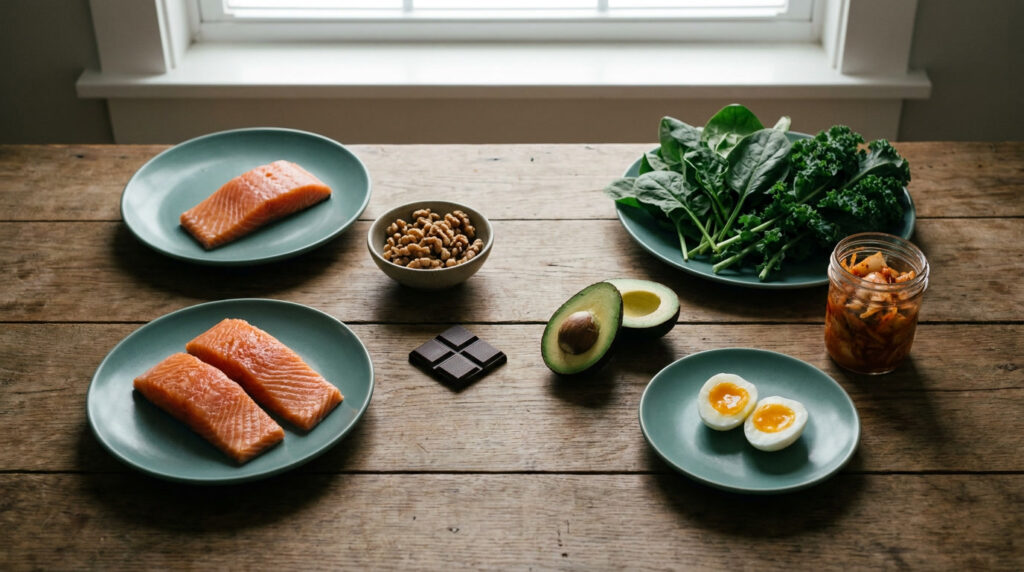
Food affects anxiety. Not as a metaphor, not as a lifestyle preference, but as a direct physiological mechanism.
What you eat influences cortisol production, neurotransmitter synthesis, gut microbiome composition, blood sugar stability, and neuroinflammation — all of which are primary drivers of the physiological environment in which anxiety either thrives or diminishes. Dietary patterns aren’t a replacement for therapy or nervous system regulation practices. But they’re a meaningful variable in the anxiety equation, and one that’s almost always underaddressed.
This guide covers the foods with the strongest evidence for anxiety reduction — not as a superfood list, but with the mechanism explained for each, so you understand what you’re doing and why it works.
The 7-Day Mind Reset addresses anxiety through multiple physiological pathways — including the dietary and nutritional inputs that directly affect the nervous system and gut-brain axis. Get it here →
How food affects anxiety — the mechanisms
Before getting into specific foods, it’s worth understanding the pathways through which diet influences anxiety. There are four primary mechanisms.
Neurotransmitter precursors. The brain’s anxiety-regulating neurotransmitters — serotonin, GABA, dopamine — are synthesized from dietary precursors. Tryptophan (from food) is converted to serotonin. Glutamate and glutamine (from food) are precursors to GABA. Without adequate dietary supply of these precursors, neurotransmitter production is limited regardless of how well the brain’s synthesis machinery works.
Blood sugar regulation. Blood sugar fluctuations directly trigger the stress response. When blood sugar drops — after high-glycemic meals, during fasting, or in people with blood sugar regulation issues — the body releases cortisol and adrenaline to restore it. These stress hormones produce physiological anxiety symptoms that are difficult to distinguish from psychological anxiety. A diet that maintains stable blood sugar significantly reduces this cortisol-driven physiological anxiety component.
Gut microbiome composition. As covered in our guide to the gut-brain connection, the gut microbiome produces neurotransmitter precursors, regulates the HPA axis, and maintains gut barrier integrity in ways that directly affect anxiety. Diet is the primary determinant of microbiome composition — what you eat shapes which bacteria thrive and which diminish, and therefore which neurochemical signals the gut sends to the brain.
Neuroinflammation. Chronic low-grade inflammation — driven by diet, stress, and gut dysbiosis — crosses the blood-brain barrier and produces neuroinflammation that’s strongly associated with anxiety and depression. An anti-inflammatory diet reduces the inflammatory substrate that contributes to anxiety’s physiological intensity.
Foods that reduce anxiety — organized by mechanism
For serotonin production: tryptophan-rich foods
Serotonin — the neurotransmitter most directly associated with mood stability, anxiety reduction, and sleep quality — is synthesized from tryptophan, an essential amino acid that must come from diet. Approximately 95% of the body’s serotonin is produced in the gut from dietary tryptophan, with the remaining 5% produced in the brain.
The highest tryptophan-containing foods include turkey, chicken, eggs, cheese, tofu, salmon, pumpkin seeds, and dark chocolate. The conversion of tryptophan to serotonin requires adequate B vitamins (particularly B6) and magnesium as cofactors — meaning these foods work best for serotonin production in the context of a nutrient-replete diet overall.
An important nuance: tryptophan competes with other large neutral amino acids for transport across the blood-brain barrier. Consuming tryptophan-rich foods alongside complex carbohydrates — which trigger insulin release and clear competing amino acids from the bloodstream — increases tryptophan’s transport to the brain and its conversion to serotonin. This is the neurochemical basis for carbohydrate cravings in anxious and depressed states — the brain is attempting to self-medicate with the dietary combination that increases serotonin production.
For GABA support: fermented foods and specific amino acids
GABA — gamma-aminobutyric acid — is the brain’s primary inhibitory neurotransmitter, directly counteracting the excitatory activity that drives anxiety. Low GABA activity is strongly associated with anxiety disorders, and many anti-anxiety medications (benzodiazepines) work by enhancing GABA receptor function.
Dietary support for GABA comes from several directions. Fermented foods — kimchi, sauerkraut, kefir, miso — contain bacteria that produce GABA directly, and these GABA-producing bacteria can colonize the gut and produce GABA locally. Green tea contains L-theanine — an amino acid that increases GABA activity and produces the characteristic “calm alertness” associated with tea consumption, without the sedation of GABA receptor medications. Whole grains, spinach, broccoli, and potatoes contain glutamate that serves as a GABA precursor.
For blood sugar stability: protein, fat, and fiber at every meal
Blood sugar stability is one of the most immediately actionable dietary interventions for anxiety — producing noticeable improvements in physiological anxiety symptoms within days of implementation. The principle is simple: every meal should contain protein, healthy fat, and fiber, which together slow glucose absorption and prevent the post-meal blood sugar spikes and crashes that trigger cortisol and adrenaline release.
Protein sources: eggs, fish, legumes, chicken, Greek yogurt, tofu, nuts. Fat sources: avocado, olive oil, nuts, fatty fish, eggs. Fiber sources: vegetables, legumes, whole grains, fruits. Meals built around these three components — rather than refined carbohydrates alone — produce stable blood sugar curves that significantly reduce the cortisol-driven anxiety that blood sugar fluctuation generates.
The timing matters too: skipping breakfast or going long periods without eating — common in busy, anxious people — allows blood sugar to drop and cortisol to rise, producing physiological anxiety before the day has given you anything cognitive to be anxious about. Eating within 60 minutes of waking, and eating balanced meals every 4 to 5 hours, maintains the blood sugar stability that prevents this cortisol amplification.
For the gut microbiome: diversity and fermented foods
Microbiome diversity — associated with better mental health outcomes including lower anxiety — is primarily driven by dietary plant diversity. The target of 30 different plant foods per week, drawn from across vegetables, fruits, legumes, whole grains, nuts, seeds, and herbs, provides the diverse fiber types that feed different bacterial communities and maintain a rich, resilient microbiome.
The specific foods with the strongest microbiome-supporting evidence for anxiety include: garlic and onions (high in fructooligosaccharides that feed Bifidobacterium), asparagus (inulin — a prebiotic fiber), bananas (particularly slightly unripe ones, which contain resistant starch), oats (beta-glucan, which feeds multiple beneficial bacterial strains), and legumes (diverse fiber types that produce short-chain fatty acids associated with reduced neuroinflammation and improved mood).
For neuroinflammation: omega-3 fatty acids
Omega-3 fatty acids — particularly EPA (eicosapentaenoic acid) and DHA (docosahexaenoic acid) from fatty fish — are among the most well-evidenced nutritional interventions for anxiety reduction, with multiple randomized controlled trials showing significant reductions in anxiety symptoms with supplementation.
The mechanism is primarily anti-inflammatory: EPA and DHA produce anti-inflammatory eicosanoids that reduce neuroinflammation, improve the fluidity of neuronal cell membranes, and support the production of neuroprotective factors including BDNF. The modern Western diet is significantly deficient in omega-3s relative to omega-6s — producing a pro-inflammatory state that amplifies anxiety’s physiological intensity.
Food sources: fatty fish (salmon, sardines, mackerel, herring — 2 to 3 servings per week), walnuts, flaxseeds, and chia seeds. For people who don’t eat fish, a high-quality EPA/DHA supplement (1 to 2g combined daily) has the strongest evidence for anxiety reduction in the supplementation literature.
For magnesium: dark leafy greens, nuts, and seeds
Magnesium is involved in over 300 enzymatic processes in the body, including the regulation of GABA receptors, cortisol production, and the HPA axis stress response. Deficiency — highly prevalent in adults eating standard Western diets — is strongly associated with elevated anxiety and is a common finding in people with anxiety disorders.
Dietary sources with the highest magnesium content: dark leafy greens (spinach, Swiss chard), pumpkin seeds, almonds, dark chocolate (70%+ cocoa), avocado, legumes, and whole grains. The modern food system — with its heavy reliance on processed foods and depleted soils — makes meeting magnesium needs through diet alone challenging, which is why magnesium glycinate supplementation (discussed in our sleep hygiene guide) is one of the most commonly recommended dietary supplements for anxiety and sleep.
For cortisol regulation: adaptogens and specific herbs
Several herbs and food compounds have demonstrated cortisol-modulating effects that directly reduce anxiety’s physiological substrate.
Ashwagandha (Withania somnifera) has the strongest evidence base among adaptogenic herbs — multiple randomized controlled trials showing significant reductions in cortisol, anxiety scores, and stress symptoms with 300 to 600mg daily of standardized extract. The mechanism involves modulation of the HPA axis and direct effects on GABA receptors.
Green tea’s L-theanine (discussed above under GABA) also directly modulates alpha brainwave activity and reduces cortisol, producing measurable anxiety reduction within 30 to 60 minutes of consumption. Passionflower has GABA-modulating effects comparable to low-dose pharmaceutical anxiolytics in several studies. Lemon balm reduces cortisol and anxiety through GABA transaminase inhibition.
Foods that make anxiety worse
Equal in importance to knowing what helps is knowing what actively makes anxiety worse — and removing or reducing it.
Caffeine. Caffeine blocks adenosine receptors, increases cortisol and adrenaline, reduces GABA activity, and directly mimics and amplifies the physiological symptoms of anxiety — racing heart, shallow breathing, muscle tension, and hypervigilance. For people with anxiety disorders, caffeine consistently worsens symptoms. Reducing to one cup in the morning, eliminating after midday, and replacing afternoon coffee with green tea (which provides caffeine alongside anxiety-buffering L-theanine) is the practical approach.
Alcohol. While initially sedating, alcohol increases anxiety in the second half of the night (through cortisol rebound), disrupts sleep architecture, depletes B vitamins and magnesium needed for neurotransmitter synthesis, and worsens gut permeability. Regular alcohol use is strongly associated with increased anxiety over time, not decreased. The short-term relief is borrowed against a long-term cost.
Ultra-processed foods. High in refined carbohydrates (blood sugar dysregulation), artificial additives (gut microbiome disruption), trans fats (neuroinflammation), and low in the fiber, micronutrients, and phytocompounds that support neurotransmitter synthesis and anti-inflammatory processes. A diet dominated by ultra-processed foods creates and maintains the nutritional deficiencies and gut dysbiosis that amplify anxiety’s physiological intensity.
High-sugar foods and refined carbohydrates. Produce rapid blood sugar spikes followed by crashes that trigger cortisol and adrenaline release — the physiological anxiety that many people experience mid-morning after a high-sugar breakfast, or mid-afternoon after a high-carbohydrate lunch.
A practical dietary approach for anxiety reduction
The dietary changes that most consistently reduce anxiety are not dramatic overhauls — they’re specific, targeted adjustments that address the mechanisms above.
Start with these three: eat breakfast with protein and fat within 60 minutes of waking (blood sugar stability), add one serving of fatty fish or walnuts daily (omega-3s and neuroinflammation), and reduce caffeine to one cup before midday (cortisol and physiological anxiety). These three changes address three of the most directly actionable dietary drivers of anxiety and produce noticeable improvements in physiological anxiety symptoms within one to two weeks for most people.
Build from there: add fermented foods for microbiome support, increase plant diversity toward 30 types per week, and add magnesium-rich foods or supplementation if sleep and anxiety remain problematic. This approach addresses the nutritional foundations of anxiety systematically rather than through isolated additions.
You eat three times a day — make it work for you
Every meal is an opportunity to either amplify or reduce the physiological substrate of anxiety. Not dramatically — no single meal changes anxiety. But consistently, over days and weeks, the dietary pattern shapes the neurochemical environment, the gut microbiome, the inflammatory state, and the blood sugar stability that together determine the physiological intensity of the anxiety experience.
You don’t need a perfect diet. You need a diet that provides enough tryptophan for serotonin, enough magnesium for GABA, enough fiber for a diverse microbiome, enough omega-3s to counter neuroinflammation, and enough protein and fat at each meal to maintain the blood sugar stability that prevents cortisol-driven anxiety.
That’s not a restrictive diet. It’s a nourishing one — and for an anxious nervous system, nourishment is medicine.
At Relaxation and Balance, we create tools and content for people who want to quiet the mental noise — for good. Explore the rest of the blog, watch our YouTube channel, or start the 7-Day Mind Reset if you’re ready to commit to a full week of change.