
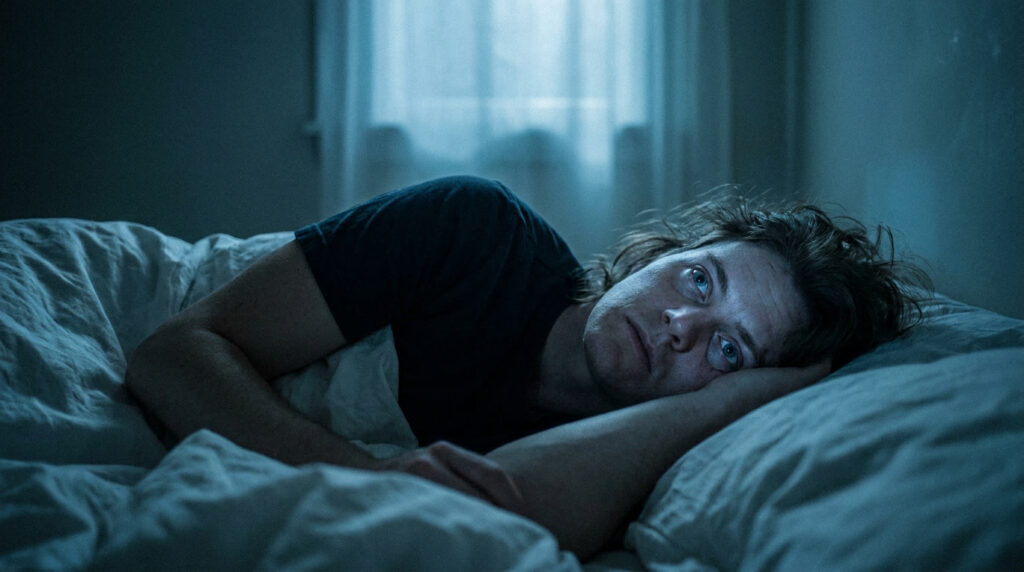
You’re exhausted. Genuinely, deeply exhausted. Your body aches for rest. Your eyes want to close.
And you cannot sleep.
You lie down and the mind activates. Or the body feels wired despite the exhaustion. Or you drift toward sleep and then jolt back awake, repeatedly, until frustration and tiredness become indistinguishable. Or you simply lie there, acutely aware that you’re not sleeping, watching the hours pass.
This particular experience — tired but unable to sleep — is one of the most common and most misunderstood sleep complaints. It has a name in sleep medicine: paradoxical insomnia, or more accurately, hyperarousal-driven sleep initiation failure. And it has specific causes that explain exactly why the exhaustion isn’t translating into sleep — and specific solutions that address those causes directly.
Why you can be exhausted and unable to sleep at the same time
The intuitive assumption is that exhaustion should lead automatically to sleep. The body is tired — surely it will simply shut down? But sleep and tiredness are driven by different biological systems, and when those systems are in conflict, tiredness doesn’t win.
Sleep is governed by two systems: the homeostatic sleep drive (how much adenosine has accumulated in the brain since you last slept — the biological “pressure” to sleep) and the circadian arousal system (the brain’s active promotion of wakefulness at specific times of day, regardless of sleep pressure). Additionally, for most people who experience tired-but-can’t-sleep, a third system is involved: the hyperarousal system — the sympathetic nervous system’s activation that keeps the brain alert even when both sleep pressure and circadian timing would otherwise support sleep.
When the hyperarousal system is active — driven by anxiety, stress, an overactivated nervous system, or the conditioned arousal that develops from repeated experiences of lying awake — it overrides the sleep-promoting signals. The brain receives simultaneous messages: “sleep now” (from adenosine and the circadian system) and “stay alert” (from cortisol, adrenaline, and the threat-detection system). The arousal signal wins, because evolutionarily it’s more important to stay awake during a threat than to sleep when tired.
This is why tired-but-can’t-sleep is so frustrating: the exhaustion is real, the sleep drive is real, but neither is sufficient to override the arousal signal that the anxious or stressed nervous system is continuously generating.
The 7-Day Mind Reset addresses hyperarousal directly — a complete daily protocol designed to lower the baseline activation that keeps the tired brain awake. Get it here →
The most common reasons you’re tired but can’t sleep
1. Chronic nervous system hyperarousal
The most common cause — particularly in people with anxiety, chronic stress, or a history of sleep problems. The nervous system has become conditioned to maintain a state of low-grade activation that doesn’t switch off at bedtime. Cortisol levels that should be dropping in the evening remain elevated. The amygdala’s threat-detection system continues scanning for danger even in a safe bedroom in the dark. The result is a brain that’s biologically exhausted but neurologically alert — tired but wired.
This is the pattern that responds most directly to nervous system regulation practices — the breathwork, somatic exercises, and vagal stimulation techniques covered throughout this blog. Addressing the physiological arousal directly, rather than trying to “force” sleep through willpower, is the key intervention.
2. Conditioned arousal — the bed-wakefulness association
After repeated experiences of lying awake in bed — struggling to sleep, feeling frustrated, watching the clock — the brain begins to associate the bed with wakefulness and arousal rather than with sleep. This is classical conditioning, and it works against you: getting into bed becomes a conditioned stimulus for alertness rather than sleepiness.
The paradox: the more exhausted and desperate for sleep you become, the more time you spend in bed trying to sleep, the stronger the bed-wakefulness association becomes, and the harder sleep gets. Effort makes it worse. The solution — counterintuitively — is to spend less time in bed, not more.
3. Cognitive hyperarousal — an overactive thinking mind
Racing thoughts, planning, problem-solving, worry, and rumination are forms of cognitive arousal that activate the prefrontal cortex and maintain the brain in an alert, processing state even when the body is exhausted. The thinking mind doesn’t distinguish between daytime and nighttime — if there are problems to solve and worries to process, it will process them regardless of what the clock says.
The techniques for quieting cognitive hyperarousal at night — the cognitive shuffle, the brain dump, the scheduled worry window — are covered in detail in our guide to the mind that won’t stop at bedtime.
4. Circadian misalignment
If your biological clock is set to a different time than your behavioral schedule — a common consequence of irregular schedules, insufficient morning light, or evening screen use — you may be genuinely tired while simultaneously being in the circadian “wake maintenance zone” — the period in the late evening when the brain actively promotes wakefulness to prevent falling asleep too early. Getting into bed 1 to 2 hours before the biological bedtime produces exactly the tired-but-can’t-sleep experience, because the circadian arousal system is working against the sleep pressure.
5. Cortisol timing issues
Cortisol, the primary stress and alertness hormone, follows a daily rhythm — peaking in the morning and declining through the day. In people with dysregulated HPA axis function — common in chronic stress, anxiety, and sleep disruption — this rhythm is often flattened or delayed. Evening cortisol that should be low remains elevated, producing the characteristic “tired but wired” feeling: physical exhaustion without the physiological calm that sleep requires.
6. Stimulants and substances
Caffeine after midday, alcohol in the evening (which produces a cortisol rebound in the second half of the night), nicotine (a stimulant), and certain medications all contribute to the tired-but-can’t-sleep state through different mechanisms. The physical sedation of fatigue is present, but the chemical stimulation overrides the sleep initiation process.
7. Medical factors
Sleep apnea (which fragments sleep without full waking awareness, producing progressive sleep debt and daytime fatigue while making sleep itself feel elusive), restless leg syndrome, chronic pain, thyroid dysfunction, and certain medications can all produce tired-but-can’t-sleep patterns. If behavioral interventions don’t produce improvement within 2 to 3 weeks of consistent implementation, medical evaluation is appropriate.
What to do when you’re tired but can’t sleep: 9 interventions
1. Stop trying to sleep — try to rest instead
This reframe is the most important intervention for hyperarousal-driven sleep failure. The effort to sleep creates arousal that prevents sleep — a self-defeating loop. Shifting the goal from “I must fall asleep” to “I’m going to rest comfortably with my eyes closed” removes the performance pressure that’s driving the arousal.
Rest — lying still in the dark with eyes closed — is genuinely restorative, even without sleep. And paradoxically, removing the pressure to sleep creates the physiological conditions in which sleep is most likely to arrive spontaneously. Sleep cannot be forced; it can only be allowed.
2. Extended exhale breathing — immediately
When lying awake despite exhaustion, the first physiological intervention is extended exhale breathing: inhale through the nose for 4 counts, exhale slowly through the mouth for 8 counts. Repeat 8 to 10 cycles. This directly activates the vagus nerve and parasympathetic system — counteracting the cortisol and sympathetic activation that’s keeping the brain alert despite the body’s exhaustion.
This is not relaxation as a concept — it’s a direct physiological intervention that measurably shifts the brain’s arousal state within minutes. Do it before any cognitive technique, because no cognitive technique works well from within a state of full sympathetic activation.
3. Body scan — move attention from head to body
Tired-but-can’t-sleep is fundamentally a problem of a mind that won’t disengage — thinking, planning, worrying, or simply running anxious background noise. Moving attention from the head into the body provides a present-moment anchor that competes with the thinking loop.
Without changing position or opening your eyes: bring attention to the soles of your feet. Notice whatever sensation is there. Move slowly upward — ankles, calves, knees — spending 10 to 15 seconds per area, just noticing. Don’t try to relax anything. Just notice. The present-moment physical anchor displaces the cognitively arousing content that was maintaining wakefulness.
4. The cognitive shuffle
Choose a random neutral word — “umbrella,” “library,” “meadow.” Visualize it letter by letter, creating an unconnected, slightly absurd mental image for each letter. The randomness disrupts the logical narrative quality of cognitive hyperarousal and mimics the random, illogical imagery of the hypnagogic state just before sleep. Most people don’t make it through the full word.
5. Get up after 20 minutes of lying awake
If 20 minutes have passed and sleep hasn’t come, get up. Go to another room. Keep the lights dim. Do something calm — read a physical book, do gentle stretching, sit quietly. Return to bed only when genuinely drowsy. This protects the bed-sleep association that conditioned arousal has been eroding — every time you stay in bed awake, the association gets weaker. Every time you leave and return only when sleepy, it gets stronger.
6. Use audio strategically
For minds that need something external to follow — particularly when cognitive hyperarousal is the primary issue — a guided sleep meditation or healing frequency audio at low volume provides an anchor for attention that competes with the mind’s own narrative. The external voice or sound gives the brain’s processing capacity somewhere to go that doesn’t generate further arousal. Keep the volume low — just audible, not immersive.
7. Address daytime habits that are driving the evening arousal
Tired-but-can’t-sleep at night is almost always partly driven by what happened during the day. Afternoon caffeine, insufficient movement, no meaningful break from cognitive demand, excessive screen time, high emotional stress — these produce the evening cortisol elevation and nervous system activation that makes sleep initiation impossible despite exhaustion. The morning routine for anxiety and the daytime practices covered throughout this blog address this layer directly.
8. Warm bath or shower if not done pre-sleep
If a warm shower wasn’t part of the pre-sleep routine and you’re now lying awake, getting up to take a short warm shower (5 to 10 minutes) and then returning to bed takes advantage of the core temperature drop mechanism — the cooling after the shower accelerates the temperature reduction that promotes sleep onset. This combines usefully with the “get up after 20 minutes” instruction.
9. Remind yourself: even rest is restorative
One of the drivers of conditioned arousal is catastrophic thinking about the consequences of not sleeping — which generates further cortisol and further arousal in a self-reinforcing loop. Challenging this thinking with an accurate reframe reduces its power: lying still with eyes closed in the dark, even without sleep, allows the body to rest and the brain to process. It’s not the same as sleep, but it’s not nothing. Removing the catastrophic urgency around sleep failure is itself a meaningful intervention for the arousal that drives it.
When tired-but-can’t-sleep becomes chronic
If tired-but-can’t-sleep is an occasional experience — during unusually stressful periods, after disrupted schedules, before significant events — the interventions above will typically resolve it within a few nights of consistent application.
If it’s a chronic pattern — present most nights for weeks or months — the issue is deeper than can be resolved by individual sleep techniques. The nervous system has become chronically dysregulated; the bed-wakefulness association has become deeply conditioned; and the anxiety about sleep itself may have become a primary driver of the insomnia. This pattern responds well to CBT-I (cognitive behavioral therapy for insomnia) with a trained practitioner, combined with the nervous system regulation practices that address the physiological substrate.
The 7-Day Mind Reset addresses the chronic pattern through a complete daily protocol — simultaneously reducing daytime cortisol load, improving sleep pressure management, and implementing the full evening wind-down and pre-sleep nervous system practices that create the conditions for sleep to arrive naturally rather than through effort.
The tired brain can sleep — it just needs the right conditions
Tired-but-can’t-sleep is not a permanent condition. It’s the result of specific biological systems in conflict — and those systems can be brought back into alignment through specific, targeted interventions applied consistently.
The exhaustion you feel is real. The sleep drive is real. The arousal system that’s currently overriding both of them is also real — but it’s trainable. With the right inputs, at the right times, it can learn to stand down at night.
Tonight: stop trying to sleep. Breathe slowly. Scan the body. Let the mind find something random to follow. And trust that the exhaustion and the sleep drive are working in your favor — they just need the arousal signal to get out of the way.
That’s what these practices are designed to do.
At Relaxation and Balance, we create tools and content for people who want to quiet the mental noise — for good. Explore the rest of the blog, watch our YouTube channel, or start the 7-Day Mind Reset if you’re ready to commit to a full week of change.